 EN
EN

Etching, Porosity, and Structural Integrity Around Sink Cutouts
Carrara marble vanity tops with integrated stone sinks face inherent material limitations that demand careful engineering. Its high porosity, with water absorption averaging 0.2% to 0.3% by weight per ASTM C97, makes it vulnerable to moisture intrusion around the sink cutout, where constant exposure can weaken the substrate over time. With a Mohs hardness of just 3 to 4, the stone is also highly susceptible to etching from acidic substances like citrus-based cleaners or even mild soap residues. Unlike granite, Carrara's calcium carbonate composition reacts chemically upon contact, leaving permanent dull marks that require mechanical refinishing to restore. Structurally, the sink cutout creates a stress riser. Natural veins and fissures, central to the marble's aesthetic, often serve as propagation paths for hairline cracks under the weight of a filled sink or repeated thermal cycling. Fabricators commonly embed steel rods or fiberglass mesh beneath the slab to reinforce these zones, yet the transition from solid stone to sink rim remains a persistent weak point. Vibration from water flow can accelerate micro-fractures, gradually compromising long-term integrity. These interrelated challenges make balancing aesthetics and function especially demanding.
Sealing Demands and Long-Term Maintenance Implications
Sealing is essential but not sufficient for Carrara marble vanity tops. A penetrating sealer reduces water absorption by filling pore spaces, yet it does not prevent etching, nor does it eliminate the need for vigilant care. As recommended by the Marble Institute of America, sealers must be reapplied every 6 to 12 months in high-moisture environments. In integrated sinks, standing water and soap film accelerate sealer degradation, often requiring more frequent maintenance than on less-exposed surfaces like backsplashes or floors. Homeowners frequently overlook the need for pH-neutral, non-abrasive cleaners; even a single improper cleaning can strip the sealer and expose raw stone. Over time, the surface develops a patina, a softened, matte finish some embrace as character, but in a sink area, this can trap dirt and bacteria if not cleaned diligently. Resealing around the sink rim is particularly challenging: the bond between the stone and carved basin or adjacent sink material may inhibit full sealer penetration, leaving a vulnerable seam. A 2023 field study by a leading stone care manufacturer found that 78% of marble vanity owners with integrated sinks reported visible etching or discoloration within two years. This underscores a key reality: while customization is possible, the ongoing commitment is substantial.
Undermount Integration vs. Seamless Solid Surface Hybrid Solutions
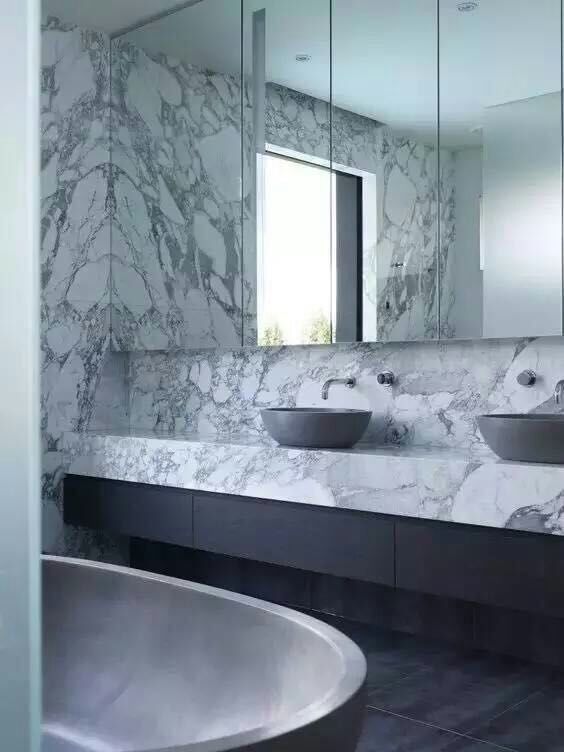
When customizing Carrara marble vanity tops, homeowners face two primary routes for an integrated sink. The undermount approach pairs a separate sink bowl, typically porcelain or engineered quartz, suspended beneath the marble's cutout. This method sidesteps marble's vulnerability to etching and staining around the sink rim, simplifying cleaning and extending the top's functional life. The visible joint is minimal, and the sink can be replaced without disturbing the stone. True seamless integration requires carving the sink basin directly from the same marble slab. While visually striking, this approach demands meticulous sealing and carries elevated risk of hairline cracking from thermal shock or structural stress. A practical middle ground is the solid surface hybrid: a non-porous solid surface sink, veined to closely match Carrara, is chemically bonded to the underside of the marble top. The result appears seamless, preserves the marble's visual continuity, and eliminates the sink-specific maintenance burden entirely. For reference, undermount integration with porcelain or quartz offers high durability and low maintenance, though the marble top still needs sealing; seamless marble from the same slab provides moderate durability but very high maintenance with regular sealing and etching risk; while the solid surface hybrid delivers high durability and low maintenance as the sink itself is non-porous.
Precision Templating, Fabrication Limits, and Lead-Time Considerations
Achieving a seamless fit hinges on digital templating. Fabricators use laser measurement to capture exact vanity dimensions, including wall irregularities that could cause gapping, ensuring precision before cutting begins. The process is unforgiving: Carrara marble's brittleness means the minimum bridge thickness around sink cutouts must remain at least 3 centimeters to avoid fracturing during transport or installation. Attempts at ultra-thin edges or complex sink contours significantly raise breakage risk, so most reputable shops enforce conservative design thresholds. These constraints, combined with the need to book-match veining across the top and sink basin, routinely extend lead times to 6 to 8 weeks. Custom orders involving specific slab selection or solid surface hybrid fabrication can add another 2 to 3 weeks. Early planning is therefore essential to align with renovation timelines.
Finishes, Edges, and Real-World Performance Trade-Offs
Choosing the right finish and edge profile for Carrara marble vanity tops directly shapes both beauty and resilience. A polished finish magnifies the stone's iconic veining and depth but also makes early-stage etching from acidic toiletries far more visible. A honed, matte surface diffuses light and masks minor scratches and etches, though it may require more frequent cleaning to avoid a dull, smudged appearance. Edge design is equally critical: a sharp square edge offers elegance but is prone to chipping, especially around the sink cutout where structural stress concentrates. A rounded or beveled edge better dissipates impact forces, reducing the risk of spalling from dropped cosmetic tools. The interplay between finish and edge becomes especially important in integrated-sink applications, as the transition zone is both high-traffic and high-moisture. Even with a high-quality impregnating sealer, a polished edge near the sink will show water spots and soap residue more starkly than a honed, eased edge. Ultimately, the most durable configuration balances an understated surface that forgives everyday wear with an edge profile that softens vulnerable points, without sacrificing the visual lightness and refinement that define Carrara marble's enduring appeal.
Frequently Asked Questions
What makes Carrara marble vulnerable in integrated sink applications? Carrara marble has high porosity and a Mohs hardness of 3 to 4, making it prone to water absorption, etching from acidic substances, and structural stress around sink cutouts.
Can sealing completely protect Carrara marble countertops? Sealing reduces water absorption but does not prevent etching or eliminate maintenance needs. Regular reapplication and careful cleaning with pH-neutral products are essential.
What is the difference between undermount and seamless sink integration? Undermount sinks pair a separate bowl beneath the marble cutout, reducing maintenance challenges, while seamless sinks are carved directly from the marble slab but require higher maintenance.
How does edge design impact durability? Honed and rounded edges dissipate stress and reduce the risk of chipping, particularly around sink cutouts, while polished square edges may show water spots more prominently.
What are the lead-time considerations for custom Carrara marble vanity tops? Custom fabrication typically requires 6 to 8 weeks, with additional time for specific slab selection or hybrid sink integration, so early planning is crucial.