
 EN

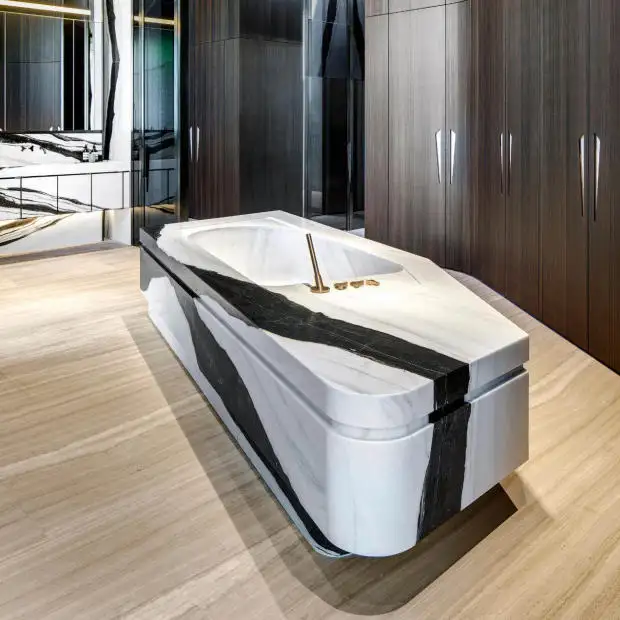
Specifying panda white walls for a hotel lobby or corporate reception is a decision that balances visual calm with practical performance. A coastal resort recently renovated its double-height arrival lobby and initially planned small tiles across a curved twelve-meter reception wall. The first problem appeared during sampling: grout lines broke the veining and the pale ground showed every joint under the atrium skylight. The team switched to large-format slabs with a honed finish and a book-matched layout, then paired the wall with warm 3000 K grazing light. The result was a continuous, restful backdrop that housekeeping maintains with a simple daily wipe.
Specification Decisions For Large-Area Wall Cladding
Large vertical surfaces magnify every material weakness that goes unnoticed on a sample board. A wall clad in natural stone must hold its tone, resist marking and stay safe under public contact for a decade or more. Getting the format and finish wrong forces either costly rework or a compromised appearance that the client sees every day.
Slab Versus Tile For Panda White Walls
Choosing between slab and tile changes how panda white walls perform over thousands of square feet. Large-format slabs reduce grout lines and deliver uninterrupted veining, which suits a feature reception wall. Tile format offers simpler handling, lower replacement cost and easier calibration across batches; suppliers working to ISO 9001:2000 keep tone bands documented for repeat orders. For tall expanses, a 12 mm or 15 mm slab fixed to a bonded substrate minimizes visible seams, while tile remains practical for service corridors where impact repair matters more than continuity.
Managing Veining Continuity Across Big Surfaces
Natural stone carries directional veining that must flow across a wall rather than fight it. On panda white walls, layout teams dry-lay full elevations on the floor, marking each panel's position so the grain travels horizontally or vertically without abrupt breaks. A consistent book-matched sequence keeps the black veins balanced on both sides of a central axis. Without this planning, a large wall looks patched and restless, undermining the calm the stone was chosen to provide.
Book-Matching And Pattern Layout
Book-matching pairs adjacent slabs cut from the same block so their mirrored faces form a symmetric figure. On panda white walls this technique turns a plain partition into a sculptural focal point behind a reception desk. Pattern layout should be approved from printed photographs before fabrication, because quarry variation means no two blocks share identical movement. A clear elevation drawing signed off by the design team prevents costly re cuts on site.
Lighting Interaction With Pale Stone Surfaces
How Color Temperature Changes Perceived Tone
Pale stone is highly responsive to the light above it. On panda white walls, a 3000 K warm source softens the white ground and makes black veins feel graphic yet inviting, while a 4000 K neutral light renders the surface cooler and more corporate. Light temperature should be selected together with the finish, since the same slab looks different under each. Sampling a full panel under the actual fixtures during mock-up avoids expensive surprises after handover.
Controlling Glare On Wall Cladding
A polished finish reflects both light and fingerprints, which can create hot spots on a wall facing windows or spotlights. For panda white walls in bright atriums, honed or satin finishes scatter reflection and read as matte and restful, a safer choice than polish. Dimmable fixtures and baffled downlights reduce direct glare, while grazing light from the side reveals the stone's depth without washing it out. The finish decision therefore belongs in the lighting plan, not after installation.
Maintenance In Commercial Traffic Areas
Wall cladding in a commercial building faces a different duty cycle than a residential feature wall. Staff carts, cleaning routines and humidity from adjacent entrances all act on the surface. A maintenance plan written before handover keeps the stone readable and prevents the slow dulling that turns a premium material into a tired one.
Daily Cleaning Protocol For Busy Lobbies
Commercial traffic brings hands, luggage wheels and cleaning chemicals into constant contact with wall cladding. On panda white walls, a pH-neutral cleaner applied with a soft microfibre cloth removes smudges without etching the calcium surface. Abrasive pads and acidic descalers must stay away from natural stone, because they dull the polish and open the pores. Housekeeping staff benefit from a one-page procedure posted near the service area, keeping daily care consistent across shifts.
Sealing And Stain Resistance
Panda white marble is more porous than granite, so a penetrating sealer is applied to the back and edges before fixing and refreshed on the face after installation. Laboratories measure absorption under ASTM C97 so porosity stays comparable between batches. The impregnation slows absorption of oils and dyes common in hospitality settings, though it does not make the wall stain-proof. Reapplication every twelve to twenty-four months preserves resistance in busy zones. Spills should be blotted promptly, since standing liquid is the main enemy of pale stone. Specifiers should request documented care guidance from a supplier certified to ISO 14000, since responsible quarrying and factory water treatment protect both the material supply and the project's green credentials.
Panda white walls reward careful specification with a serene, high-end backdrop that few materials match for commercial calm. Success depends on choosing slab or tile by location, planning veining continuity before fabrication, pairing the finish with the right light temperature and committing to a simple maintenance rhythm. When these steps are respected, the stone performs reliably across lobbies, receptions and corridors for years.
Frequently Asked Questions
Question
Should a pale marble feature wall use slab or tile format?
Answer: Slab format suits panda white walls where uninterrupted veining matters most, reducing grout lines across large elevations. Tile format handles service areas and corridors better, since individual pieces are simpler to replace after impact. The choice depends on visibility, budget and repair priority. Many projects combine both: slabs on the reception backdrop, tiles in back-of-house zones. A bonded substrate and proper fixing system keep either option stable on vertical surfaces.
Question
Why does veining continuity matter on large wall surfaces?
Answer: On a big elevation, even small tone shifts become obvious to anyone standing a few meters away. Continuous veining reads as intentional and calm, while random panel placement looks patched and restless. Dry-laying the full wall on the floor before fixing lets the team sequence each slab so the grain flows across the surface. Book-matching around a central axis balances the dark veins. This planning protects the serene effect the material was selected to deliver.
Question
How should lighting be planned for pale stone wall cladding?
Answer: Pale stone reacts strongly to the color temperature above it, so fixtures should be chosen alongside the finish during design. Warm 3000 K light softens the white ground and flatters black veins, while neutral 4000 K reads cooler and more corporate. Honed surfaces scatter reflection and avoid glare, whereas polished finishes need baffled, dimmable fixtures. A full-size mock-up under the real lamps confirms the tone before the whole wall is installed.
Question
Can a penetrating sealer make this pale stone cladding stain-proof?
Answer: A penetrating sealer slows absorption of oils, dyes and water, which helps in hospitality and transit spaces, but it does not make any natural stone fully stain-proof. The impregnation reduces how deeply liquids enter the pores, giving staff time to blot spills before marking occurs. Reapplication every twelve to twenty-four months maintains protection in busy zones. Prompt wiping and a pH-neutral cleaner remain essential, because standing liquid on pale marble still causes lasting discoloration.
Question
Where should slab quality be verified before wall installation?
Answer: Slab quality should be checked at the supplier yard and again on site before fixing. Inspection covers tone consistency, vein direction, edge calibration and absence of fissures across the batch. Standards such as ISO 9001:2000 guide documented quality control, while ASTM C97 measures absorption and ANSI A137.1 covers slip and surface performance. Approving a printed elevation from sample photographs prevents mismatched panels. Verifying at the source reduces rework and protects the calm, continuous look planned for the wall.