
 EN

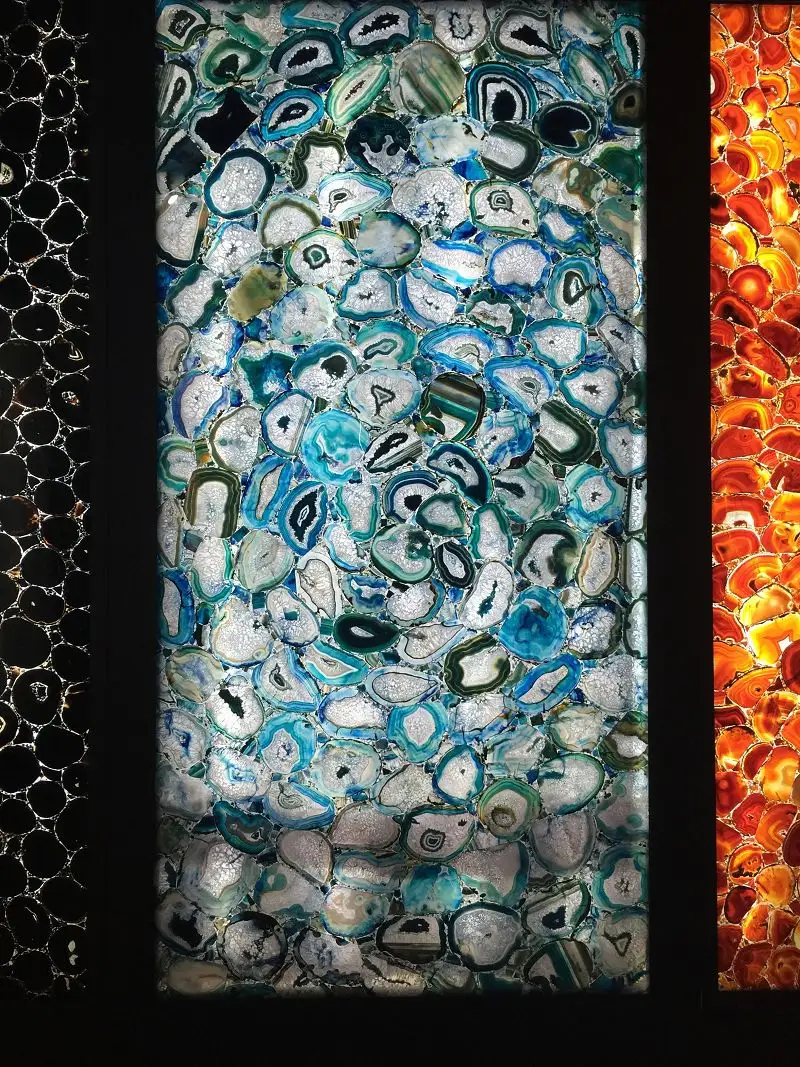
Blue agate countertops bring a depth of color and light that traditional stone surfaces rarely achieve, which explains their growing presence in upscale hospitality and residential interiors. Formed from banded chalcedony, the material carries layered blue tones that shift subtly as the viewing angle changes. Designers turn to it when a space needs a focal surface that feels both rare and alive. Unlike a printed finish, the pattern is geological and never repeats, giving each installation a singular identity.
A Material Unlike Marble or Granite
Why Agate Reads Different Under Light
Blue agate countertops differ from marble and granite at a structural level, because agate is a cryptocrystalline quartz rather than a coarse metamorphic or igneous rock. Its fine, interlocking crystal structure scatters light internally instead of reflecting it from a polished face. Where a marble slab shows surface veining, agate reveals internal banding that appears to glow from within. That optical behavior is the reason backlit blue agate countertops become a luminous centerpiece instead of an ordinary bar top. Granite resists impact better, yet it stays opaque and cannot deliver this glow.
Rarity and Limited Quarry Yield
Specifying blue agate countertops starts with accepting that slab yield is finite. Agate forms inside volcanic rock cavities over long geological periods, so usable decorative slabs are limited and unpredictable in size. Blue variants suitable for large surfaces are especially scarce, which raises their design value. Project planners should treat slab count as a constraint and confirm availability before committing to a layout. Sourcing from a manufacturer with its own quarries and factories, plus ISO 9001:2000 and ISO 14000 certification, helps secure consistent material for a defined project scope. Buyers should also watch for dyed or enhanced pieces that imitate natural blue depth; authentic banding shows gradual tonal change rather than flat color. Lead time should be confirmed in writing once the slab set is reserved.
The Backlighting Advantage
How Translucency Shapes a Room
Blue agate countertops rely on translucency, the trait that separates them from opaque stone. When a light source sits behind a thin agate panel, the bands diffuse into soft halos of blue and white. This effect suits dimmer, atmospheric settings such as a lounge or reception where the counter becomes a quiet source of ambient light. Specifying LED panels with even spacing avoids hot spots that break the illusion. Warm and cool LEDs change the mood of the same slab, so the chosen temperature should match the room's palette. Thin panels around 10 to 20 millimeters give even glow, since thicker stone dims the effect.
Resin Stabilization and Light Transmission
Many blue agate countertops leave the factory resin-stabilized for thin backlit work. Raw agate is too brittle and porous, so fabricators stabilize it with clear resin under vacuum. The resin fills micro-fissures and binds the stone, improving both strength and clarity of light transmission. Proper stabilization keeps color true and prevents the cloudy look caused by trapped air. ASTM C97 absorption testing offers a reference for comparing how little moisture stabilized material takes in, while ANSI A137.1 guides surface-performance expectations. EN 13501 classifies reaction to fire for interior claddings, a useful check where local codes govern hospitality fit-outs.
Design Techniques That Elevate the Look
Book-Matching for Symmetry
Blue agate countertops gain drama from book-matched layouts that mirror adjacent grain across a seam. The result is a butterfly-like band symmetry reading as one continuous stone. This technique suits long reception counters and island fronts where the eye expects a unified field. Planning the match early protects the limited slab inventory and prevents wasted cuts during fabrication. A mismatch at the seam reads as a flaw under backlight, so the layout drawing must lock grain direction before cutting begins.
Edge Profiles and Seamless Joints
A well-chosen edge profile hides thickness and refines how light meets the surface. Tapered or mitered edges let a backlit panel appear to float, while hidden adhesive joints reduce visible seams. Fabricators should dry-lay pieces under the actual lighting condition before final bonding, since color shifts are easier to correct at this stage than after installation. A polished top with a honed return also softens reflections near seating.
Specifying Agate for a Real Project
A Backlit Reception Counter in Practice
A boutique hotel lounge in a coastal city planned a front-desk counter as the guest's first impression. The team wanted a glowing blue surface but faced a narrow footprint and only three matching blue slabs on hand. The solution was a resin-stabilized, backlit agate panel sized to the available material, book-matched across the front face with concealed lighting. Early sampling revealed one slab with a darker resin patch, which the team set aside for the least visible section. The finished counter drew steady guest attention and became a recurring photo backdrop, meeting the brief without over-ordering stone.
Inspection and Maintenance Advice
Owners of blue agate countertops should inspect slabs under the intended lighting, checking for uniform banding, no dark resin patches, and consistent thickness across the lot. On site, use a pH-neutral cleaner and a soft cloth; acidic or abrasive products dull the surface and weaken seals. Wipe spills promptly and avoid placing hot items directly on the stone. Place trivets and cutting boards between the stone and daily wear, since sharp edges and high heat remain the main threats to a thin panel. A quarterly check of the backlight and seals catches fading or loosening early, before a guest notices.
Blue agate countertops earn their place in luxury interiors through internal glow, natural rarity, and craftsmanship that marble and granite cannot replicate. Careful slab planning, honest resin stabilization, and correct lighting turn a small piece of stone into a defining design moment. For projects that value atmosphere over convention, agate offers a surface worth specifying.
Frequently Asked Questions
Question
What makes agate more expensive than marble?
Answer: Agate costs more because usable decorative slabs are scarce and formation takes long geological time inside volcanic cavities. Blue variants large enough for a counter are especially limited, so each project competes for a small inventory. Added resin stabilization, precise cutting, and book-matching raise labor cost. The price reflects rarity and craftsmanship rather than a markup on common stone.
Question
Why does agate need resin stabilization?
Answer: Raw agate is brittle and porous, which makes thin backlit panels prone to cracking and dull spots. Clear resin applied under vacuum fills micro-fissures, binds the stone, and improves light transmission clarity. Without stabilization, moisture and air weaken the slab and cloud its glow. Stabilization is a standard fabrication step that protects both structure and appearance in finished installations.
Question
How are backlit agate counters lit?
Answer: A light source sits behind a thin agate panel, usually an LED array with even spacing to avoid hot spots. The stone's translucency diffuses the light into soft blue and white halos. Installers dry-lay the panel under the real lighting first, then fix concealed fixtures and a diffuser. Even illumination depends on consistent panel thickness and careful joint masking.
Question
Can blue agate be used in a kitchen?
Answer: Blue agate countertops work in kitchens when properly sealed and protected from heat and acid. The surface suits prep areas with light use more than heavy chopping zones. Use a pH-neutral cleaner, wipe spills fast, and place trivets under hot pans. Resealing on a schedule preserves the finish. With this care, agate performs well as a feature surface.
Question
Where should agate panels be inspected before purchase?
Answer: Slabs should be checked at the supplier's yard under lighting close to the final installation. Look for uniform banding, no dark resin patches, and steady thickness across the lot. Dry-lay pieces to confirm book-matched flow before shipping. Inspecting on site prevents surprises after delivery and reduces the risk of mismatched or weakened panels arriving late.