
 EN

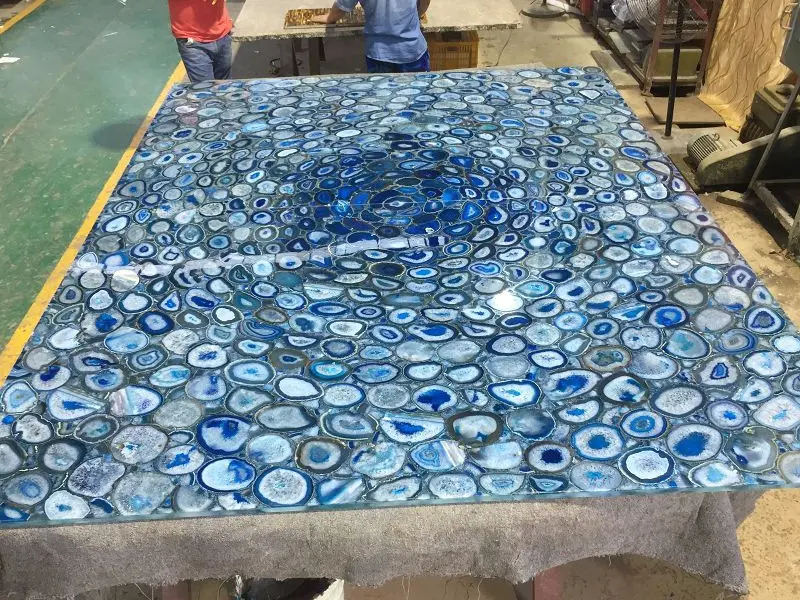
Sourcing natural stone for a premium interior fit-out carries hidden risks, and blue agate countertops sit at the fragile end of the spectrum. Unlike dense granite, agate forms in thin, fractured bands that require stabilization before they can be cut and polished. A buyer who skips verification may receive slabs that look flawless in a showroom yet fail under workshop stress. This guide walks through the practical checks that protect a project from costly rework and schedule slips.
Why Sourcing Blue Agate Demands Care
Natural Fragility and Filling Risks
Blue agate countertops begin as brittle, translucent stone that rarely survives quarrying in large flat pieces. Most commercial slabs are assembled from smaller fragments bonded with epoxy resin and a backing mesh. The stabilization step is what makes the surface usable, but the quality of that bonding varies widely between workshops. Poorly filled slabs crack along vein lines during cutting, wasting both material and lead time. An early sample cut, inspected for fracture depth, exposes whether a supplier controls its filling process or simply hides defects under gloss.
Dye and Resin Stabilization Concerns
Color is the main reason buyers choose blue agate countertops, yet dye treatment is common and not always disclosed. A slab may be soaked in pigment to deepen its blue tone, then coated with resin to mask fractures. Checking dye involves examining the edge of a cut sample under strong light: natural color shows depth and variation, while dye sits as a flat, even saturation near the surface. Requesting a resin-stabilized declaration helps confirm what was applied, and a simple acetone swipe on a hidden edge can reveal surface coatings that a polished face conceals.
A Project Owner's Supplier Vetting Story
A hospitality project owner once faced a tight fit-out deadline with three suppliers competing to supply blue agate countertops for the order. Two offered fast delivery at low rates; the third held ISO 9001 documentation and invited an on-site audit. The owner visited each workshop and found the cheaper suppliers cutting without thickness control and refusing sample tests. Choosing the audited supplier meant slower lead time, but every delivered slab met the agreed tolerance and passed backlight inspection. The fit-out finished without a single replacement, and the owner avoided a dispute that could have stalled the opening.
Slab Selection and Thickness Control
Confirm Thickness Tolerance
When sourcing blue agate countertops, confirm slabs are supplied at 18 mm or 20 mm, then verify actual measurements with a caliper. A check across multiple points should show variation within ±1 mm; beyond that, seams and mitred edges will not align. Recording each slab's thickness on the inspection report prevents arguments later. Thickness also affects how the stone handles the weight of fixtures and the stress of transport. For backlit counters, consistent thickness keeps light transmission even across the whole run, so the glow does not show bright and dim patches after installation.
Assess Translucency Under Backlight
Because agate is valued for glow, viewing slabs under a backlight during selection is essential. Natural material reveals layered, shifting bands; heavily resin-filled pieces look uniform and dull. Bringing a portable light panel to the supplier lets a buyer compare pieces side by side and reserve the brightest, most consistent lots for visible blue agate countertops runs. Once installed, daily care stays simple: a pH-neutral cleaner and soft cloth protect the surface, while heat pads guard against thermal shock that stresses fragile edges.
Supplier Audit, Certification, and Logistics
Audit Production and QC Systems
A credible supplier audit reviews cutting equipment, resin batches, and the inspection stage before packing. Ask to see how defective slabs are rejected and whether measurements are logged per piece. Workshops operating a documented QC routine catch filling gaps and thickness drift early, reducing the chance of surprises at the destination warehouse. Request references from past export projects and confirm the team handles crating for long ocean freight rather than leaving packing to a third party. Verifying resin stabilization during the audit lets buyers reject weak lots before freight, and a thickness tolerance check protects seam alignment later.
Verify ISO 9001 and ISO 14000
Requesting current ISO 9001 and ISO 14000 certificates confirms that a manufacturer follows a quality management system and environmental controls. These standards do not grade beauty, but they show disciplined process control — useful when a project spans multiple shipments. Pair the certificates with recent QC reports rather than trusting a logo on a website. A supplier that can present traceable batch records demonstrates the transparency a procurement file needs for audits and future reorders.
Apply ASTM and ANSI Tests, Plan Packing
Reference ASTM C97 for absorption and density checks and ANSI A137.1 for surface performance when specifying acceptance criteria. Crating should use foam-lined, upright frames with desiccant to protect fragile edges during ocean freight. A clear on-site inspection plan, completed before signing acceptance, closes the sourcing loop and keeps the blue agate countertops program on schedule. Reserve book-matched pairs at the order stage so adjacent panels share continuous veining instead of clashing tones across the finished surface.
Careful sourcing turns a risky purchase into a predictable one. Verifying resin stabilization, dye treatment, thickness tolerance, and supplier controls before payment separates reliable lots from decorative disappointments. Blue agate countertops reward disciplined procurement with stable, light-transmitting surfaces that hold up through installation and daily use. Build the checks into the purchase order, confirm them at the loading point, and the fit-out stays on track from slab to finished edge.
Frequently Asked Questions
Question
What documents should be requested from an agate slab supplier?
Answer: Request the current ISO 9001 and ISO 14000 certificates, recent per-slab QC reports, and a resin-stabilized declaration stating any dye or epoxy treatment. Batch traceability records help confirm consistent process control across shipments. Pair these papers with an on-site audit of cutting and packing before signing acceptance. Solid documentation reduces disputes and gives the procurement file the transparency needed for reorders and future project audits.
Question
Why is resin stabilization verification important for agate?
Answer: Agate forms in thin, fractured bands that cannot be cut into large flat surfaces without bonding. Resin stabilization fills micro-cracks and supports the slab during polishing and transport. Verifying the process confirms the piece will not delaminate or crack along vein lines later. A supplier that discloses resin type and batch shows process discipline, which matters more than showroom appearance when the stone must survive workshop stress and a long sea freight.
Question
How is slab thickness tolerance measured on site?
Answer: Use a digital caliper at several points across each slab, including corners and the center, and record every reading on the inspection report. Agate should hold within roughly ±1 mm; wider drift means seams and mitred edges will not align during installation. Consistent thickness also keeps backlight transmission even, avoiding bright and dim patches. Measure before crating so rejected pieces never leave the supplier's warehouse.
Question
Can dyed agate be detected before installation?
Answer: Yes. Examining a cut sample edge under strong light shows natural depth versus flat surface dye, and an acetone swipe on a hidden edge can lift surface coatings. Requesting a treatment declaration adds written confirmation. Catching dye early protects blue agate countertops from mismatched tones across a fitted run, since undisclosed pigment may fade or clash once the slab is fixed and lit from behind.
Question
Where should book-matched pairs be reserved during sourcing?
Answer: Book-matched pairs should be selected and tagged at the order stage, at the supplier's warehouse before cutting begins. Marking adjacent slabs keeps continuous veining across the finished surface instead of clashing tones. Reserve paired offcuts for repairs and lock pairs into the purchase order so the supplier cannot sell the piece to another buyer and break the visual flow.