
 EN
EN

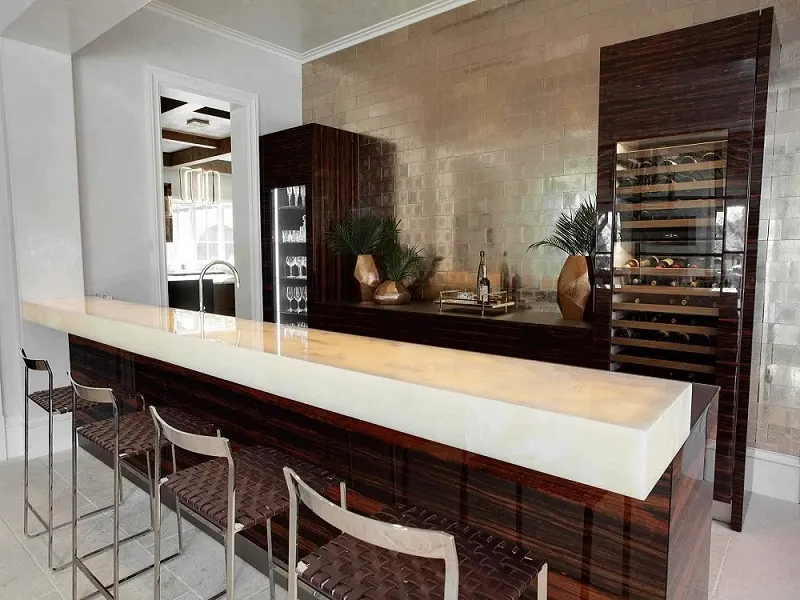
Onyx backlit wall panels turn plain surfaces into luminous architecture, and placement decides whether the effect feels calm or theatrical. A boutique hotel lobby, a restaurant bar, a spa, and a compact elevator lobby each respond to backlighting differently. Natural onyx is a banded calcite formed in mineral waters, giving it a translucency ordinary marble lacks. Choosing the location means understanding both the room and the science of light.
Ideal locations for onyx backlit wall panels
Hotel lobby and reception feature walls
Onyx backlit wall panels find their most natural home behind a hotel lobby feature wall, where guests register the space before a word is spoken. A reception backdrop lit from within reads as quiet luxury, because the glow comes from the stone. Designers often specify one uninterrupted plane so the veining carries the eye across the room. A tall, narrow slab feels intimate; a wide one becomes the building's signature. Natural onyx performs well here because foot traffic stays low and the surface stays protected. The ambiance shifts with the hour as dimmers adjust the light.
Restaurant bar, spa, and elevator lobby
A restaurant bar backdrop catches reflections in glassware and bottles, turning service into a focal point at night. Spa spaces use the same principle for calm: a soft glow behind a treatment-room wall lowers the perceived temperature and supports a slow mood. An elevator lobby is a small, high-traffic pause, so a thinner, resin-backed slab works where weight and impact matter more than scale. The goal is ambiance, not spectacle. The translucent stone should join the lighting plan rather than sit on top of it. Warm tones flatter skin and food alike.
The translucency and lighting principle
Why onyx transmits light while marble does not
Onyx transmits light while marble does not because of mineral structure. Onyx is almost pure calcite with a fine, layered grain that scatters and passes visible light. Marble is denser and more opaque at normal thickness, so a backlight yields only faint warmth. That is why a thin slab of natural onyx glows and marble stays dark behind the same fixture. Higher calcite content gives a cleaner, more uniform glow; heavy veining creates dramatic, directional patterns. The effect is physical, not a coating that can be applied later, so it cannot be faked on an opaque stone.
LED source, color temperature, and light diffusion
LED lighting is the practical heart of any backlit installation: it runs cool, lasts long, and tunes to a specific color temperature. Specifiers evaluating onyx backlit wall panels should request a sample with the exact LED strip and driver before committing, since color temperature drifts with voltage and age. Warm white near 2700–3000K flatters onyx and welcomes a hotel lobby; neutral 4000K reads cleaner. Light diffusion separates a pro result from a dotted panel: a frosted acrylic layer between the LED and stone spreads light so no diode shows.
Specifications, structure, and risk notes
Slab thickness and resin backing
The facing layer is typically cut to 6–10 mm and laminated to a resin backing or honeycomb panel for stability. This thin slab enables backlighting but invites vulnerability, so the resin backing adds flexural strength and protects the fragile face in transit. Thickness follows the span: small elevator lobby panels stay slim, while a large feature wall needs a backing system to avoid bowing. ASTM C880 flexural testing gives a reference for how the laminated assembly behaves under load, and ISO 9001 controls keep batch quality steady.
Support, fragility, and handling
Onyx is softer and more brittle than granite, so support and handling drive the risk. A backlit wall must sit on a rigid, flat substrate—usually a metal frame with sealed backing—so the slab cannot flex after fixing. Fragile edges need site protection, and cuts need continuous water cooling to avoid heat cracks. Resin-backed assemblies reduce but do not remove breakage risk, so installers plan lift points and temporary bracing first.
A boutique hotel lobby installation scenario
From design brief to glowing wall
A boutique hotel lobby in a coastal city wanted a reception feature wall that felt calm yet memorable. The team specified honey-toned onyx on resin backing, cut to 8 mm, mounted on an aluminum frame with a dimmable LED set to 3000K. A 6 mm frosted acrylic layer handled diffusion. The first mock-up showed diode hotspots, so the team added a second diffuser and re-spaced the strips. After adjustment the wall glowed evenly, the veining floated, and evening guests paused at the desk to photograph it.
What the project taught us
That boutique hotel lobby confirmed onyx backlit wall panels reward careful placement because the glow depends as much on the room as on the stone. The LED source, color temperature, diffuser, and backing must be specified together, since changing one shifts the whole effect. Buyers should inspect a full-scale sample under intended lighting before approval, confirm the resin backing thickness, and ask about slab flatness tolerance. Translucent stone rewards preparation and punishes improvisation. A maintenance note helps the operator: dust the surface and check the driver yearly, because a failing strip dims the wall unevenly.
Onyx backlit wall panels reward careful placement because the glow depends as much on the room as on the stone. Hotel lobbies, restaurant bars, spas, and elevator lobbies each call for a different balance of scale, color temperature, and support. The translucency of natural onyx comes from its calcite structure, which lets light pass where marble stays dark, and a thin slab with resin backing makes that light practical to use. Specifiers who treat lighting, diffusion, and structure as one system get the stunning result they pictured.
Frequently Asked Questions
Question
Where should a backlit onyx feature wall be placed first?
Answer: Hotel lobbies and reception areas offer the safest, most impactful start because traffic stays low and the wall remains protected. A feature wall behind the reception desk shows the translucency without exposure to impact or moisture. Restaurant bars and spas follow, where ambiance matters most. Avoid wet floors and high-contact zones unless the slab is resin backed and shielded.
Question
Can backlit onyx panels be used in a bathroom spa?
Answer: Onyx backlit wall panels suit spa and wellness spaces where a soft, even glow supports relaxation, but moisture control is essential. The stone must be resin backed and sealed, with the LED source and driver kept outside the wet zone. A feature wall behind a treatment room reads as calm luxury. Avoid direct water contact and steam saturation, which can cloud the backing over time.
Question
Why does onyx glow while marble stays dark behind light?
Answer: Onyx is built from fine-grained calcite with a layered structure that scatters and passes visible light, so a thin slab glows. Marble is denser and more opaque at normal thickness, so backlight produces only faint warmth. The difference is mineral, not finish. Higher calcite content gives cleaner, more uniform transmission, while heavy veining creates dramatic directional patterns across the surface.
Question
What slab thickness works for a backlit onyx installation?
Answer: Most backlit onyx uses a 6–10 mm facing layer laminated to resin backing or honeycomb panel for stability. Thin slabs glow well but stay fragile, so backing choice depends on span and support. Small elevator lobby panels can remain slim, while a large feature wall needs a rigid frame to prevent bowing. ASTM C880 flexural testing gives a reference for how the laminated assembly behaves under load.
Question
How should a backlit onyx wall be maintained?
Answer: Dust the stone surface regularly with a soft, dry cloth and avoid acidic or abrasive cleaners that etch calcite. Check the LED driver and strips annually, since a failing unit dims the wall unevenly. Inspect edges and corners for chips after any nearby work. Keep the backing dry and the substrate stable. With steady care the translucent stone keeps its glow for many years of service.