
 EN
EN

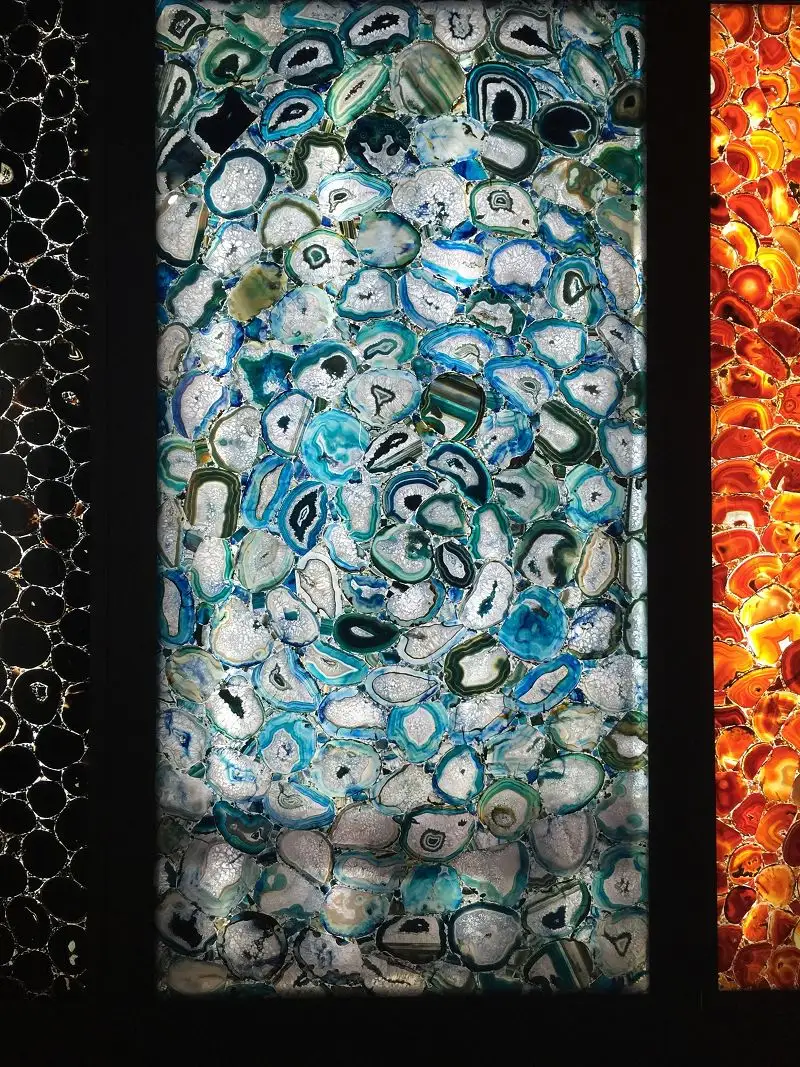
A boutique hotel in the Gulf recently reopened its lobby with a reception desk that stops guests mid-step. The original brief asked for something durable yet theatrical, a piece that survived daily service while reading as art. The project team wanted a surface no one could ignore, and blue agate countertops delivered exactly that effect. Unlike a slab of quarried marble set flat, agate carries a depth that seems to glow from within. The reason sits in geology, not marketing.
Why agate looks nothing like ordinary stone
What creates those bands of color
Standing in front of a polished blue agate countertops installation, most people notice the parallel ribbons first. Those bands form because agate is a variety of chalcedony, a microcrystalline quartz that fills cavities in volcanic rock. As mineral-rich water seeps slowly into a hollow, layers of silica settle in rhythmic cycles. Each band records a change in temperature, chemistry, or flow rate. Trace amounts of iron and copper tint the layers blue and teal, so the color is structural rather than painted on. That slow deposition is why no two slices ever match.
Translucency and the role of chalcedony
The second trait that separates agate from marble is light. Chalcedony crystals are fine enough that thin pieces let light pass, giving a translucent quality. A polished blue agate countertops slab over a lit panel shows this translucency most clearly. Polished marble mostly reflects light from its surface; agate transmits it through the stone. A skilled fabricator thins the slab and mounts it over a panel, turning a heavy material into a luminous one. This behavior traces back to the crystal size—microcrystalline structure scatters less light than coarse granite grains.
Agate versus marble and granite
Structure and hardness compared with granite
Granite earns its reputation from interlocking minerals and high compressive strength, rated on ASTM C615 for building stone. Agate is harder in scratch terms, near 7 on the Mohs scale because it is quartz-based, but it is also more brittle. A thin agate feature cannot take the same point loads as a granite worktop. The main risk is impact: a dropped bottle can chip a thin edge. That is why installers bed the panel on a flat substrate and limit overhang. The honest trade is clarity over brute strength. Specifiers choose agate where the visual moment matters more than daily chopping.
Pattern and porosity versus marble
Marble shows sweeping veining from metamorphic recrystallization, while agate shows concentric or horizontal banding from fluid deposition. Marble is also more porous and reactive to acid, so a lemon spill etches it quickly. Agate resists acid better but still needs sealing because micro-pores sit below the polish. ASTM C97 measures absorption and helps buyers compare stone lots before purchase. For a busy reception, agate's lower absorption is a quiet advantage when the sealant is refreshed on schedule. The practical advice: treat agate as a feature surface, not a prep board.
Making agate usable as a countertop
Book-matching across a feature slab
Because agate slabs are small and costly, a single piece rarely spans a long bar. A long run of these agate slabs relies on book-matching to stay seamless. Fabrication solves this through book-matching: two adjacent cuts are opened like a book so their patterns mirror. The result reads as one continuous ribbon across the countertop. Good book-matching depends on selecting blocks with consistent banding and cutting them on the same plane. The effect lifts a luxury interior from pleasant to memorable without adding more stone.
Resin backing and substrate support
Commercial agate slabs almost always ship with resin backing. Agate is too thin and fragile to stand alone, so most commercial pieces ship with resin backing bonded to a substrate such as honeycomb aluminum or glass. The resin fills micro-cracks and adds flexural strength measured under ASTM C880. Request the backing certificate; reputable makers hold ISO 14001 for environmental control. This backing also flattens the slab for a clean install over a cabinet or steel frame. Buyers should ask how thick the natural layer is and what substrate carries the load, since that ratio decides long-term stability.
Where blue agate countertops earn their place
Backlit bars and reception counters
The Gulf hotel solved its wow problem by backlighting the reception desk with warm LEDs behind a thin agate panel. Light travels through the translucent stone and the blue bands seem to move as guests walk past. A backlit bar top creates the same theater in restaurants and clubs. Specifying blue agate countertops for a bar means planning the light source first. The scene works because agate is a natural stone that was never meant to be opaque; giving it light reveals the pattern that ordinary tops hide.
Procurement and care for buyers
Specifiers should request samples cut from the actual block, confirm the resin backing thickness, and verify ISO 9001 and ISO 14001 certificates from the manufacturer. Daily care stays simple: wipe with pH-neutral cleaner, avoid abrasive pads, and reseal annually depending on traffic. A luxury bar with heavy glass movement benefits from felt pads under bottles. Ask for a mock-up panel lit the same way as the final location. These steps keep the surface vivid for years without special coatings.
Blue agate countertops stand apart because their beauty is built into the material, not applied on top. The banded chalcedony carries mineral traces that no factory finish can copy, and thin fabrication with resin backing turns a brittle gem into a working surface. From a backlit reception desk to a feature bar, the stone earns attention through light and depth. Buyers who check the substrate, sealing plan, and certifications get a surface that performs as well as it photographs.
Frequently Asked Questions
Question
What makes agate translucent compared with marble?
Answer: Agate transmits light because its microcrystalline chalcedony has crystals too small to scatter beams. Marble reflects light from a polished surface and stays opaque. Thinning the slab and mounting it over a panel lets light pass through, producing the glow. This property comes from crystal size, not from any coating or treatment added during fabrication.
Question
Why does agate show banded patterns instead of veining?
Answer: Bands form when silica-rich water fills a rock cavity in slow cycles, laying down thin layers that record changes in temperature and mineral content. Iron and copper traces tint each layer blue or teal. Marble veining comes from metamorphic heat pressing minerals into lines. The difference is fluid deposition versus recrystallization, which is why agate reads as ribbons and marble as sweeping lines.
Question
How is a thin agate slab made strong enough for a countertop?
Answer: Fabrication bonds the natural stone to resin backing over a rigid substrate such as honeycomb aluminum. The resin fills micro-cracks and the substrate carries point loads, so the slab resists flexing. Installers bed it on a flat, continuous support and limit overhang. Flexural performance is checked under ASTM C880, giving buyers a measurable basis to compare slabs before a project commits to a specific block.
Question
Can agate surfaces handle a busy bar environment?
Answer: Blue agate countertops work well in bars when specified as feature surfaces rather than prep stations. The resin-backed slab resists casual glass movement, and lower absorption than marble helps near ice and spills. Daily wiping with pH-neutral cleaner keeps the polish. Heavy chopping or hot pans belong on a separate station, since the thin stone prefers admiration over abuse.
Question
Which backing substrate supports agate for vertical and horizontal use?
Answer: Honeycomb aluminum is common for both walls and counters because it stays light yet rigid. Glass backing suits backlit panels where light must pass cleanly. The choice depends on load direction and whether the piece is lit. Buyers should confirm the backing thickness and request the manufacturer certificate, then match the support frame to the slab size during the design phase.