
 EN
EN

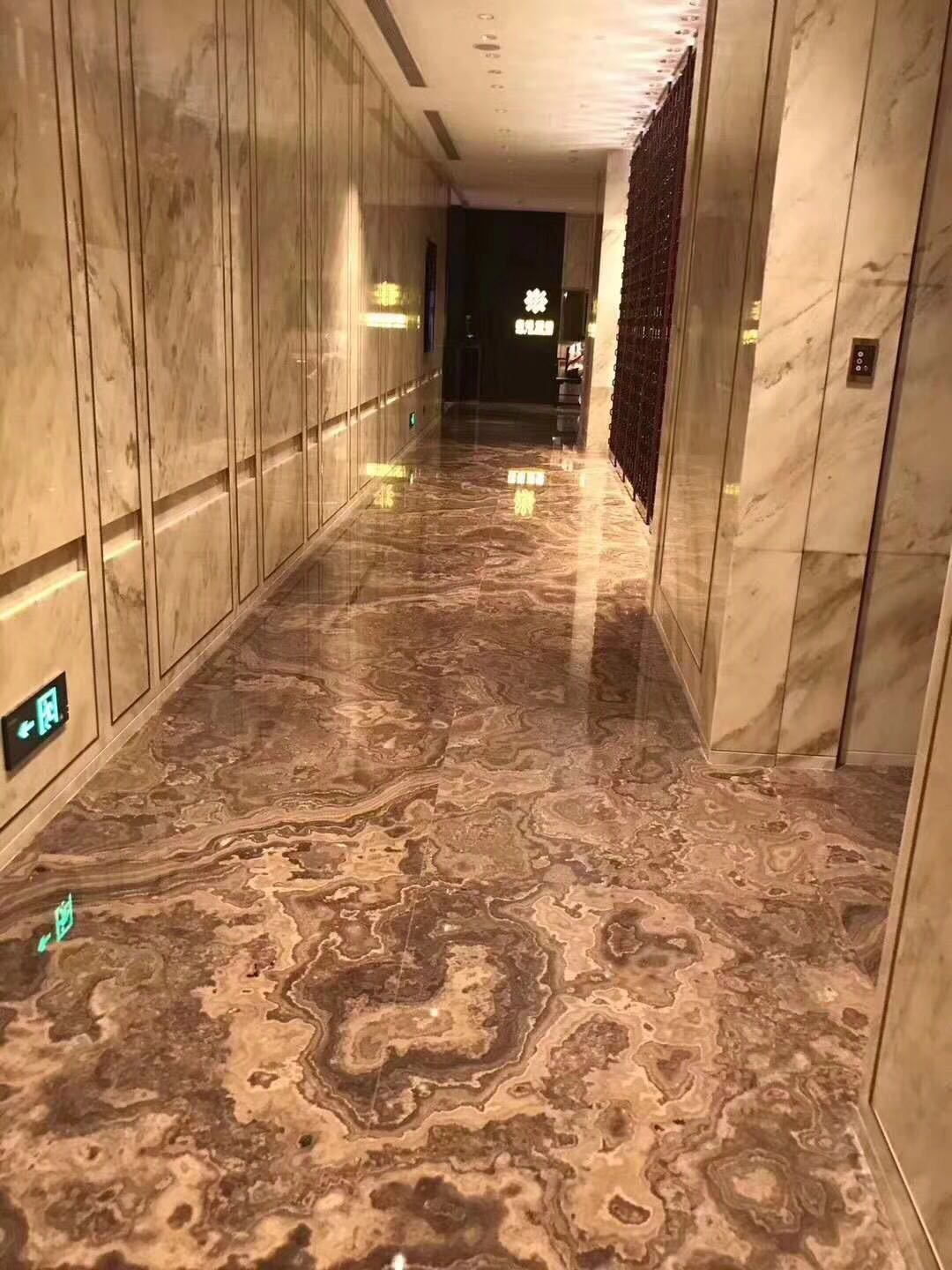
Polished Marble Flooring in High-Traffic Areas: Why It Dulls and How to Protect It
Walk into any busy hotel lobby, corporate office, or retail space with polished marble flooring, and you will notice something after a few years: the once-mirror-like surface looks worn, dull, and uneven. Traffic lanes—those paths where people walk most frequently—lose their luster first.
The reality is that polished marble is not like other flooring materials. Its beauty comes with specific vulnerabilities that facility managers and building owners must understand. Here is what you need to know about why polished marble dulls faster in high-traffic areas—and what you can do about it.
Why Marble Loses Its Shine
The dulling of polished marble follows a dual degradation process: chemical etching and mechanical abrasion. These two forces work together, accelerating wear far faster than either would alone.
Chemical Etching
Marble‘s primary component is calcium carbonate, which reacts readily with acids. Beverage spills, food residues, and even some cleaning solutions dissolve microscopic surface layers, creating matte, light-scattering patches. This is not staining—it is a permanent alteration of the stone’s surface.
Mechanical Abrasion
Foot traffic grinds fine grit, sand, and dust into the polished surface, acting like sandpaper. Over time, this physical scratching removes the polished layer, exposing the duller stone beneath.
The synergy: Acid-driven dissolution weakens the surface, making it more susceptible to abrasion. The result is visible traffic lanes—dull, uneven paths where reflectivity is irreversibly compromised. Restoring uniform sheen requires professional honing and repolishing, not routine cleaning.
From the field: A facility manager at a 500-room hotel shared: “We noticed dulling in the main lobby corridor within 18 months. At first, we tried different cleaning products thinking that would fix it. It did not. We eventually learned that the damage was already done—we needed professional refinishing.”
Polished vs. Honed: A Strategic Choice
The finish choice presents a functional trade-off that should be dictated by traffic expectations.
| Feature | Polished Marble | Honed Marble |
|---|---|---|
| Appearance | High-gloss, mirror-like finish | Smooth, matte finish |
| Pore structure | Closed (more stain-resistant) | Open (requires more frequent sealing) |
| Visual depth | Exceptional | Moderate |
| Etching visibility | Highly visible (stark dull blemishes) | Well-masked (pre-etched texture absorbs visual impact) |
| Best application | Low-traffic luxury spaces | High-traffic commercial areas |
| Maintenance frequency | Lower (if protected) | Higher (more frequent sealing) |
The key insight: Polished marble achieves its high gloss through progressive grinding that closes pores, enhancing stain resistance and visual depth—but its mirror-like surface makes etching instantly conspicuous. Honed marble, by contrast, has a smooth, matte finish that inherently masks acid damage, preserving visual consistency despite similar chemical vulnerability.
While honed marble demands more frequent sealing, it maintains a uniform appearance longer in lobbies, corridors, and reception areas. Selecting honed over polished is a strategic adaptation to traffic intensity—not a compromise on quality.
Prevention: Stopping Damage Before It Starts
Entryway Matting and Zoned Protection
Since 80% of floor contaminants enter on footwear, entryway matting is the most effective first line of defense.
Best practices:
-
Install wide, high-traction walk-off mats (minimum 15 linear feet) both inside and outside main entrances
-
Reinforce heavy traffic zones—near elevators, reception desks, and corridor junctions—with resilient runner carpets or area rugs
-
A 2023 facility maintenance survey found such zoned protection reduces the need for professional restoration by up to 40%
-
Complement with daily dry-dust mopping using clean, untreated microfiber pads
Furniture Management
Concentrated loads pose a silent threat to polished marble, risking scratches, micro-cracks, and localized deformation.
Best practices:
-
Fit all chair legs, table bases, and heavy furniture with thick felt or soft rubber pads—replace them quarterly
-
Swap hard casters for non-marking, soft-wheeled alternatives rated for hard surfaces
-
Always lift—not drag—furniture during reconfiguration
-
Distribute weight under heavy items using wide-base glides
A 2022 commercial flooring report notes that a 200 kg static load concentrated on a small footprint can cause permanent structural distortion in marble.
Cleaning: What Actually Works
pH-Neutral Cleaners Are Non-Negotiable
Chemical etching—not dirt—is the leading cause of premature sheen loss. Because marble is composed of calcium carbonate, it reacts destructively with both acids and strong alkalis.
| Cleaner Type | Effect on Marble | Recommendation |
|---|---|---|
| pH-neutral (pH 7) | Safe; cleans without damaging | Non-negotiable for daily use |
| Acidic (vinegar, citrus) | Dissolves surface; causes etching | Never use |
| Alkaline (bleach, ammonia) | Damages polish; dulls surface | Never use |
| Abrasive cleaners | Physical scratches; removes polish | Never use |
Commercial maintenance data shows 85% of polished marble degradation in lobbies stems from inappropriate cleaning agents (Stone Care Institute, 2022).
Optimal Cleaning Frequency
| Task | Frequency | Best Practice |
|---|---|---|
| Dry dust-mopping | Daily | Removes abrasive grit before it scratches |
| Damp mopping (pH-neutral) | Weekly | Removes embedded oils and grime |
| Deep cleaning / sealer check | Quarterly | Inspect water beading; re-seal if moisture spreads |
| Professional honing | As needed (traffic lanes visible) | Restores damaged surface |
Research confirms that 70% of finish loss results from inconsistent frequency, not volume of traffic (International Sanitary Supply Association, 2023).
From the field: A building services manager at a Class A office tower implemented a strict pH-neutral cleaning protocol after discovering that their previous janitorial staff had been using a general-purpose alkaline cleaner. “Within three months, we saw a noticeable improvement,” he said. “The floors stopped dulling as quickly, and we extended the time between professional refinishing from 18 months to 30 months.”
Sealing: The Protective Barrier
Sealing is critical for safeguarding polished marble in commercial spaces. In high-traffic zones, impregnating sealers—preferred over topical coatings—should be reapplied every six to twelve months.
| Sealer Type | How It Works | Best Application |
|---|---|---|
| Impregnating (penetrating) | Fills pores beneath the surface | High-traffic marble; preserves natural look |
| Topical coating | Forms surface film | Low-traffic areas only; can yellow or peel |
| Enhancing sealer | Deepens color and veining | Dark-colored marble; aesthetic enhancement |
Application best practices:
-
Apply multiple thin coats, allowing full absorption between layers
-
Pay extra attention to wear-prone paths
-
Allow 48–72 hours of undisturbed curing before resuming cleaning or heavy foot traffic
Properly maintained sealing significantly retards moisture penetration, spill absorption, and surface abrasion—extending both aesthetic life and serviceability.
Professional Refinishing: When to Call the Experts
What Professional Restoration Does
Professional restoration addresses subsurface damage that cleaning cannot reverse. It begins with honing—using diamond-impregnated pads—to remove micro-scratches and level the stone. Technicians then progress through increasingly fine abrasives to rebuild a uniform, high-gloss finish.
This process recovers up to 95% of original reflectivity, reversing the 60% gloss loss typical in high-traffic lanes after two years (MIA, 2023).
When to Call a Professional
| Trigger | What to Look For |
|---|---|
| Traffic lane formation | Visible dull paths where people walk most |
| Sheen inconsistency | Uneven gloss across zones |
| Etching marks | Dull, chalky spots from acidic spills |
| Water absorption | Moisture darkens stone instead of beading |
Cost comparison:
-
Professional refinishing: $5–$8 per square foot
-
Full tile replacement: $15–$25 per square foot (NAHB, 2024)
Early intervention prevents deeper wear progression, preserving the floor‘s dimensional stability and extending its functional lifespan by a decade or more.
From the field: A retail chain with 30 locations implemented a quarterly inspection program. “We catch dulling early and schedule refinishing during low-traffic hours,” the facilities director explained. “We have reduced our annual floor maintenance budget by 25% just by being proactive.”
Cost-Benefit Analysis: Prevention vs. Restoration
| Strategy | Annual Cost (per sq. ft.) | Long-Term Impact |
|---|---|---|
| Do nothing | $0 (but >$5–8 for refinishing every 2–3 years) | High cost; irreversible damage |
| Basic cleaning only | $0.50–$1.00 | Moderate; refinishing still needed every 3–4 years |
| Full prevention program | $1.50–$2.50 | Refinishing every 5–8 years; 40% lower lifecycle cost |
The bottom line: Investing in prevention—mats, proper cleaning, sealing, and furniture protection—extends the time between professional refinishing from 2–3 years to 5–8 years, reducing lifecycle costs by up to 40% .
FAQ
Why does polished marble dull faster in high-traffic areas?
Polished marble‘s calcium carbonate reacts with acids and gets mechanically abraded by dirt and grit from heavy foot traffic, leading to dull patches and loss of sheen.
What is the difference between honed and polished marble finishes?
Polished marble has high gloss but reveals etching damage clearly, while honed marble has a smooth, matte finish that masks acid damage effectively, making it a better choice for high-traffic areas.
How can I protect polished marble floors in heavy traffic zones?
Use entryway mats, zone carpets, daily dust mopping, protective furniture pads, pH-neutral cleaners, and regular sealing to extend its lifespan.
What are the best cleaning agents for marble flooring?
pH-neutral cleaners prevent chemical degradation caused by both acidic and alkaline solutions. Avoid using vinegar, citrus, or abrasive products.
When should professional refinishing be performed?
Professional refinishing is necessary when dull traffic lanes form, sheen varies across surfaces, or visible etching damage occurs.