
 EN
EN

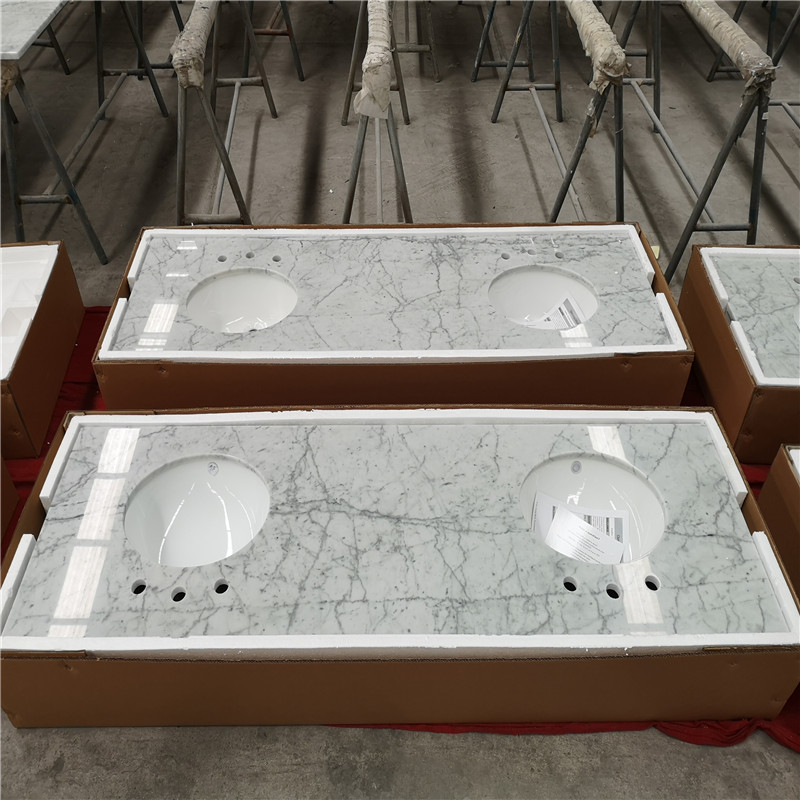
Carrara Marble Vanity Tops: Edge Selection Guide for Luxury Bathrooms
Walk into any high-end bathroom showroom, and you will see them everywhere—Carrara marble vanity tops. The soft white background, the dramatic gray veining, the timeless elegance that has made this stone a favorite of designers for centuries.
But here is the reality that many homeowners discover only after installation: not all Carrara marble vanity tops are created equal. And the edge profile you choose matters far more than aesthetics alone.
The difference between a vanity that looks stunning for decades and one that shows wear within years often comes down to one decision: the edge. Here is what architects, interior designers, and homeowners need to know about selecting the right edge profile for Carrara marble vanity tops.
Understanding the Material: What Makes Carrara Unique
Carrara marble embodies a paradox—luxurious aesthetics paired with structural vulnerability. Understanding its material properties is the first step to making an informed edge selection.
| Property | Characteristic | Design Implication |
|---|---|---|
| Mohs hardness | ~3 (relatively soft) | Prone to chipping and scratching, especially along sharp edges |
| Porosity | Naturally porous | Absorbs moisture and acidic bathroom products; requires sealing |
| Veining | Dramatic, natural patterns | Represents planes of weakness; can increase fracture risk |
| Crystalline structure | Calcite-based | Reacts with acids (etching); vulnerable to chemical damage |
What this means for edge selection:
-
Sharp corners and deep undercuts are vulnerable to chipping
-
Complex profiles can trap moisture, leading to staining
-
Veins running parallel to an edge increase fracture risk
From the field: A designer shared a cautionary tale: “We specified a sharp, square edge for a Carrara vanity in a high-end master bath. Within six months, there were chips at both front corners. We replaced it with a eased edge, and it has been perfect for five years.”
Thickness Matters: 2cm vs. 3cm
Slab thickness fundamentally shapes edge feasibility and visual authenticity. The choice between 2cm and 3cm is not just about heft—it is about durability, aesthetics, and long-term performance.
| Factor | 2cm Slab (Laminated) | 3cm Slab (Solid) |
|---|---|---|
| Construction | Often laminated to simulate greater mass | Monolithic, single-piece construction |
| Edge flexibility | Wide range of profiles possible on laminated edges | True carved profiles possible |
| Durability concern | Glue line vulnerable to humidity-induced separation | No glue line; monolithic stability |
| Visual proportion | Ornate edges can appear disproportionate | Profiles look substantial and authentic |
| Cost | Lower material cost | Higher material cost |
| Best application | Powder rooms, low-traffic areas | Master baths, high-use vanities |
The key insight: Complex profiles like full Ogee or waterfall edges are technically possible on laminated 2cm edges but carry elevated long-term risk in wet environments. In contrast, a solid 3cm slab enables true carved profiles that enhance both durability and presence.
Visually, proportion matters: an ornate edge on a thin laminated slab can appear disproportionate and artificial, while a minimal eased edge on a 3cm slab may read as visually underdeveloped. Matching edge scale to actual slab thickness reinforces structural honesty—and signals considered, high-integrity luxury.
Design Principles for Carrara Vanity Edges
Aesthetic Intent vs. Wet-Environment Durability
Luxury design with Carrara marble must reconcile aesthetic aspiration with functional reality. While delicate, sculptural edges elevate visual sophistication, bathrooms present persistent challenges: steam, splashes, and acidic toiletries accelerate etching and staining—especially along exposed or recessed edge surfaces.
Best practice: Profiles that minimize crevices and deflect moisture—like a softly eased or modestly overhanging Ogee—support both elegance and resilience.
Dual-finish strategy: Many designers now pair a honed top surface (to mask early micro-etching) with a polished edge (for crisp luminosity), creating a dual-finish strategy that preserves Carrara‘s classic refinement without compromising longevity in high-moisture settings.
Scale, Proportion, and Visual Weight
Edge depth directly influences spatial perception.
| Vanity Size | Recommended Edge Style | Rationale |
|---|---|---|
| Large master bath | Bold Ogee on 3cm slab | Anchors space with confident, traditional gravitas |
| Compact powder room | Subtle eased or small bullnose on 2cm slab | Maintains clarity and proportion |
| Modern/minimalist | Slim edge with deeper overhang | Enhances “floating” aesthetic |
| Traditional/cabinetry | Flush alignment with substantial profile | Suits classical design language |
The edge‘s scale should respond to the vanity’s footprint, ceiling height, and architectural style—not dictate it—to achieve intentional, harmonious luxury.
Top Recommended Edge Profiles
Ogee Edge: The Gold Standard for Formal Luxury
The Ogee—defined by its elegant S-shaped curve—is widely regarded as the definitive edge for formal Carrara marble vanity tops. Its sculptural depth complements Carrara‘s soft, flowing veining, reinforcing neoclassical and transitional sensibilities.
-
Best for: Master suites, formal powder rooms
-
Slab recommendation: Solid 3cm slab for full carved profile
-
Design impact: Timeless elegance; anchors traditional spaces
-
Consideration: More labor-intensive fabrication; delicate lip less forgiving in high-impact areas
NKBA design trends data shows that 72% of high-end residential designers specify Ogee edges for Carrara marble in formal settings.
From the field: A project manager at a luxury home builder noted: “We use Ogee on 3cm Carrara for our master baths almost exclusively. It is the profile that clients recognize as ‘luxury.’ We have never had a callback on an Ogee edge done on a solid slab.”
Bullnose and Eased Edges: Refined Alternatives for Family Bathrooms
When daily practicality meets refined design, bullnose and eased edges deliver superior performance for Carrara marble vanity tops.
| Profile | Description | Best For |
|---|---|---|
| Bullnose | Fully rounded edge; eliminates sharp corners | Family bathrooms, guest baths, accessible design |
| Eased edge | Subtly softened square; clean lines | High-end family residences, transitional spaces |
| Waterfall edge | Vertical extension down cabinet sides | Modern, contemporary aesthetics |
Why these work:
-
Bullnose enhances safety and reduces chipping risk
-
Eased edge retains clean lines while mitigating brittleness
-
Both are highly repeatable via CNC fabrication
-
Industry data shows eased edges account for 58% of Carrara vanity orders in high-end family residences
These profiles work seamlessly across 2cm and 3cm slabs, lowering cost and complexity while letting the stone‘s inherent beauty remain the focal point.
Maintenance and Edge Protection
Once the edge is selected, protecting it is essential for long-term beauty.
Immediate protection:
-
Apply a high-quality penetrating sealer during installation
-
Re-seal annually (more frequently in high-use bathrooms)
-
Wipe spills immediately—especially acidic products
Daily care:
-
Use pH-neutral cleaners only—never vinegar or bleach
-
Avoid abrasive scrubbers
-
Dry edges thoroughly after cleaning to prevent moisture wicking
Professional maintenance:
-
Annual seal check (water should bead on surface)
-
Professional honing every 3–5 years for high-use vanities
Cost Considerations
| Edge Profile | Relative Cost (vs. eased) | Fabrication Time | Durability |
|---|---|---|---|
| Eased (baseline) | 1× | Standard | Good |
| Bullnose | 1.3–1.5× | Moderate | Excellent |
| Ogee | 2–2.5× | Extended | Good (on 3cm slab) |
| Waterfall | 3–4× | Extended | Very good |
The bottom line: Investing in the right edge profile for your Carrara marble vanity top is not just about aesthetics—it is about long-term performance. A well-chosen edge on a properly selected slab thickness will look beautiful for decades with minimal maintenance.
FAQ
What makes Carrara marble vulnerable to damage?
Its relatively soft Mohs hardness (approximately 3), natural porosity, and dramatic veining can lead to chipping, staining, and fractures, especially in challenging edge designs.
How does slab thickness impact edge design for Carrara marble?
While 2cm slabs are often laminated and risk glue line separation, 3cm slabs offer monolithic stability allowing for intricate profiles without compromising durability.
What edge profiles are ideal for Carrara marble in family-oriented bathrooms?
Bullnose and eased edges are excellent choices for high-traffic areas as they minimize chipping risks while maintaining aesthetic appeal.
How can designers enhance the longevity of Carrara marble in wet environments?
Pairing honed surfaces with polished edges and choosing rounded profiles like eased or modest ogee edges can help minimize crevices and deflect moisture.
What is the “gold standard” edge for formal Carrara marble settings?
The Ogee edge is considered the gold standard for its sculptural grace and compatibility with neoclassical and transitional designs.